

In pallet warehouses, the usual response to growing volumes is to build upwards. When the building rules this out, whether because of planning restrictions, structural limits or simply because it already exists, the extra capacity has to come from depth instead. Traslo Raider, a technology developed by Logaut, a Modulblok Group company, combines a pallet stacker crane with the Raider satellite, which travels into multi-depth lanes and engages each pallet on its 800 mm short side. At the Eurobevande hub, two Traslo Raider units serve three multi-depth levels within a clear height of 6,700 mm. They hold reserve stock on the upper levels and replenish the gravity roller lanes on the lower level, where operators pick orders. This article examines the system architecture, how short-side handling shapes lane geometry, the criteria for comparing the system with fork-type stacker cranes and conventional satellite shuttles, and the reference standards for safety and the cold chain.
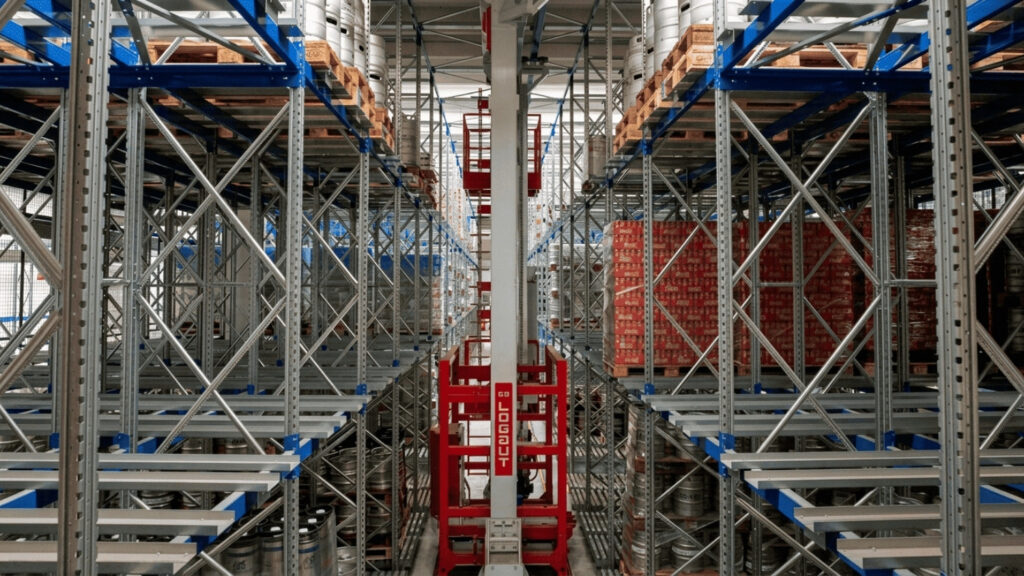
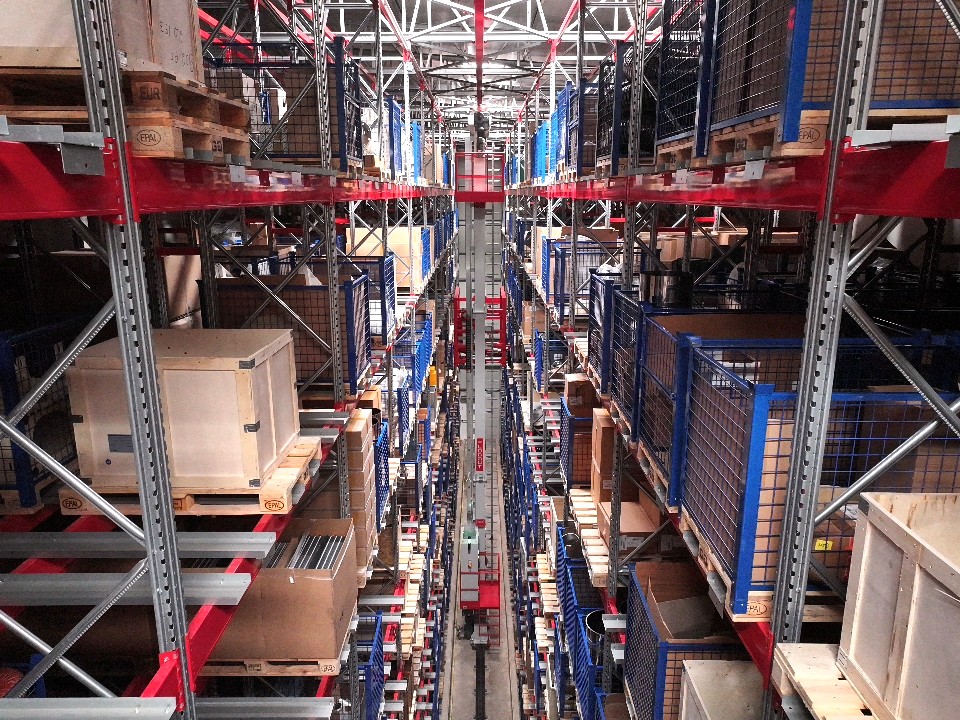
Traslo Raider is an automated multi-depth pallet storage system that combines two machines. A stacker crane travels along the aisle and lifts the load to the required level, and a Raider satellite (or shuttle) leaves the stacker crane and moves into the storage lane. It is one of three configurations of Logaut’s patented Raider® technology, alongside the L-Raider system and multi-level shuttle systems.
According to Logaut’s product data sheet, the system, also known as T-Raider, combines the proven stacker crane concept with the Raider satellite. Once the machine reaches the designated level, the satellite transfers into the lane to store or retrieve the load unit. The warehouse is designed to operate without personnel inside it: the only openings are the infeed and outfeed bays, and the perimeter is enclosed by safety guarding.
| Typical specification | Value | |
|---|---|---|
| Load capacity | Up to 1,500 kg | |
| Installation height | Up to 25 m | |
| Maximum travel speed | 3 m/s | |
| Maximum lifting speed | 0.6 m/s | |
| Minimum operating temperature (Polar version) | −30 °C |
In an automated warehouse served by a conventional stacker crane, capacity grows mainly vertically, by adding levels along each aisle served. Where height is restricted, each machine serves fewer locations, and the aisles account for a larger share of the overall footprint. Independent logistics planners also point to multi-depth storage at limited heights as a scenario in which a conventional stacker crane becomes less cost-effective.
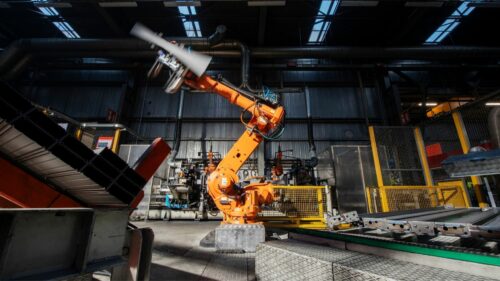
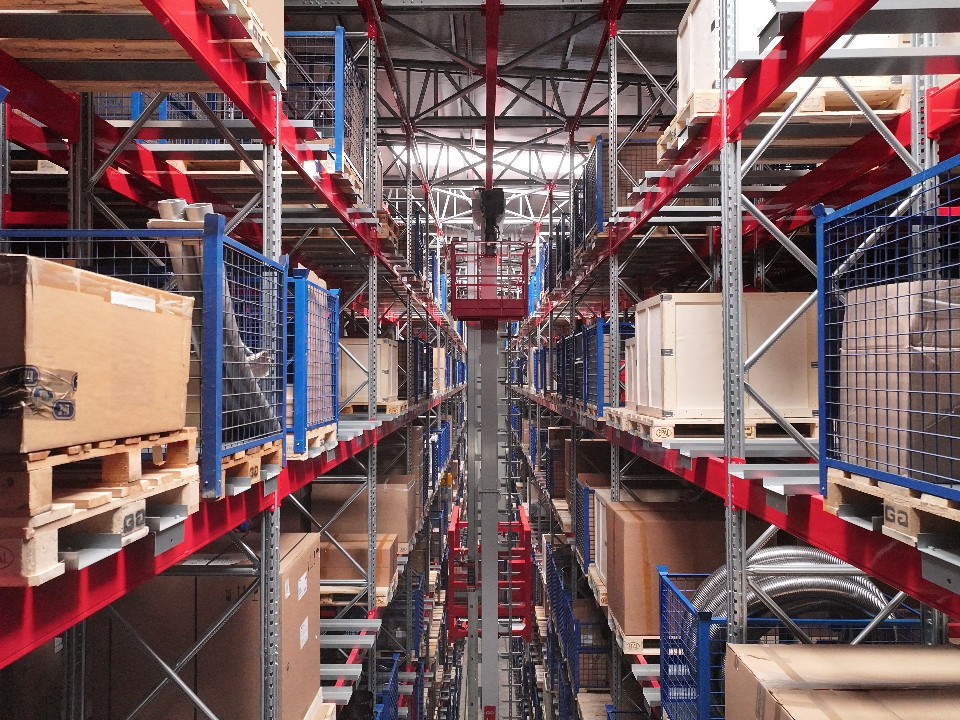
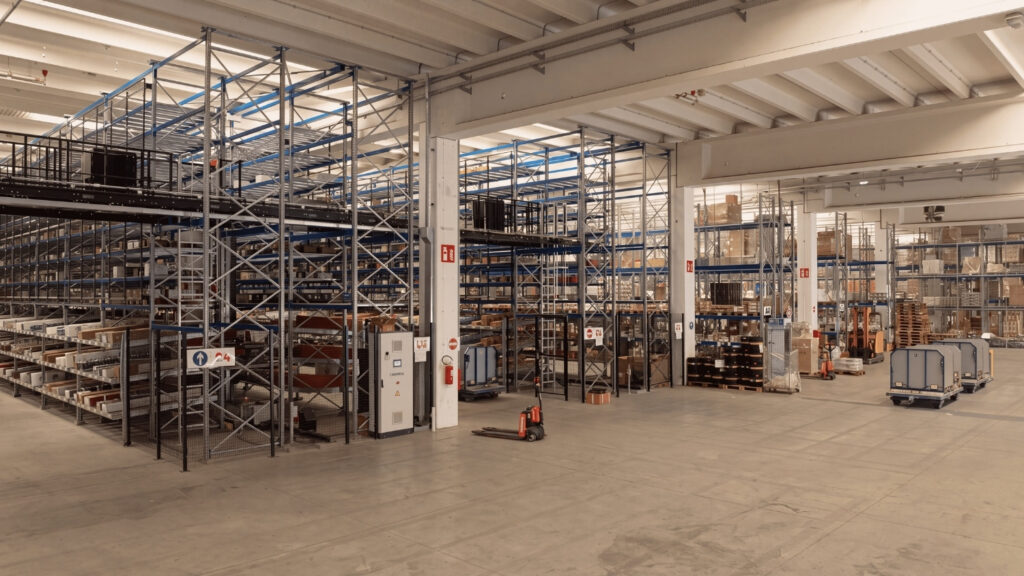
The Eurobevande hub is a case in point, with an available clear height of 6,700 mm. Configured across three multi-depth levels, the two Traslo Raider units reclaim through depth the capacity the building cannot offer in height (Eurobevande case study).
The system is not limited to low-rise buildings: the Logaut data sheet specifies installation heights of up to 25 m. At lower heights, however, the contribution of multi-depth storage is more evident, because it makes up for levels the building cannot add.
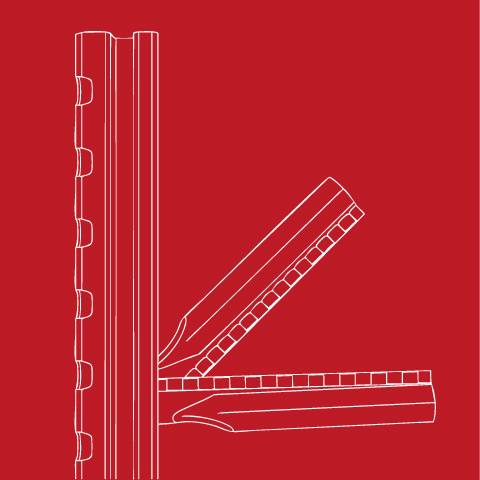
The Raider satellite engages the pallet on its 800 mm short side, using the fork entries as its pick-up point (Modulblok, Raider technology). Conventional satellite shuttles, D’Incà Levis notes, typically handle the pallet from its long side.
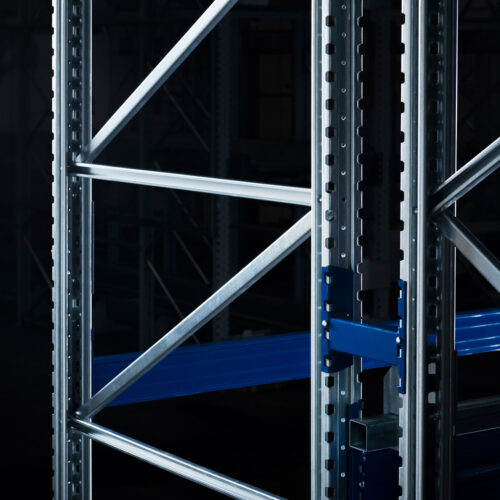
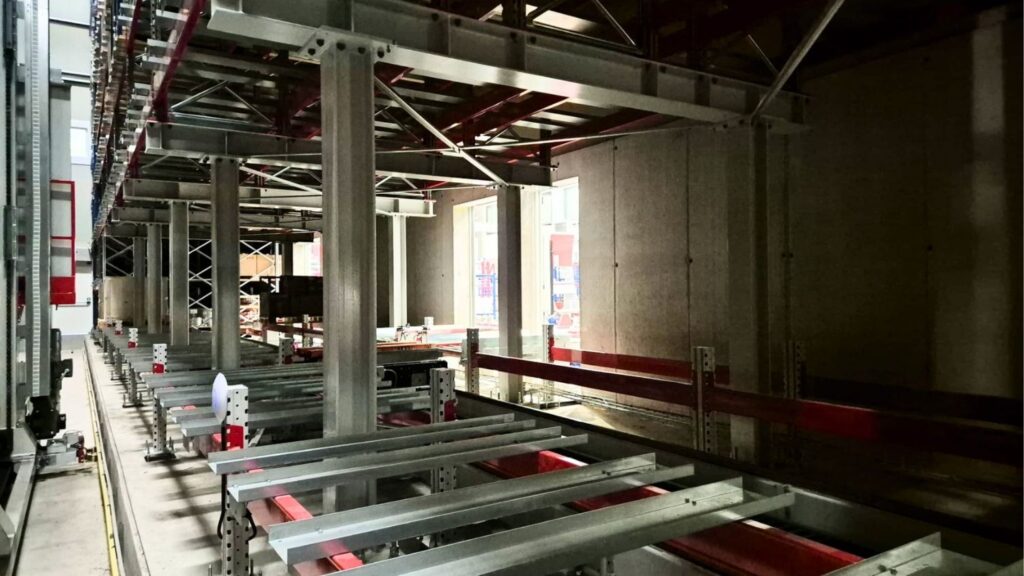
This choice changes the lane in three ways. First, each lane has a narrower face, so for the same available width more lanes open onto the aisle: Modulblok cites a 70% increase in the number of lanes along the aisle face. Second, each lane holds fewer pallets for the same floor area, which Logaut says translates into higher performance and a greater number of SKUs that can be managed. Third, the satellite uses the fork entry as its sole engagement space. It runs on rails resting on the support beams, with no special guides required, and according to the Logaut data sheet this reduces structural costs. Overall, Modulblok reports that Raider technology reduces the lanes’ footprint along the aisle and increases the number of pallets that can be stored.
For anyone evaluating a high-density warehouse, the number of lanes along the aisle face therefore becomes a design parameter in its own right: it determines how many SKUs remain accessible without sacrificing depth.
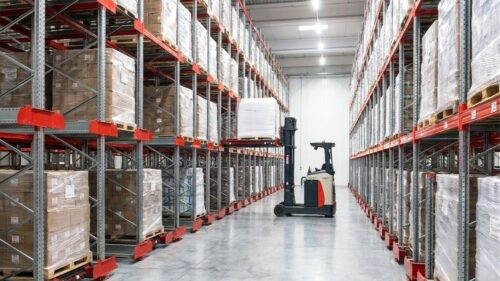
In Eurobevande’s two Traslo Raider systems, the upper levels hold reserve pallet stock, while the lower level is fitted with gravity roller lanes from which operators pick while riding tugger trains. The system replenishes the roller lanes from the reserve stock above, so storage and the pick face share the same footprint.
For the hub as a whole, the case study specifies 800 × 1,200 mm and 1,000 × 1,200 mm pallets weighing up to 900 kg. Full load units are handled by stacker and reach-truck AGVs, while a supervisory WMS coordinates missions and routes across the entire site. On the carton side, the same replenishment role is performed by a 12,000-carton miniload system feeding the carton flow lanes.
Traslo Raider’s load capacity of up to 1,500 kg exceeds the maximum pallet weight at the hub, which is 900 kg. In its Polar version, the system is equipped to operate at temperatures down to −30 °C (Logaut product data sheet). According to Modulblok, Raider technology can also work in temperature-controlled or sub-zero cold rooms, where it reduces both the volume to be refrigerated and internal handling.
In storage facilities for quick-frozen foodstuffs, Regulation (EC) No 37/2005 requires air temperature recording instruments that comply with EN 12830, EN 13485 and EN 13486. The requirement applies to the storage room rather than the machine, but it needs to be built into the design of the automated system from the layout stage onwards.
The Eurobevande case shows that in a low-rise building, capacity is gained by working on geometry rather than height: pallet orientation, the number of lanes along the aisle face, and the vertical split between reserve stock and picking. Planning and energy constraints are making this approach increasingly common, as the experience of the Dutch market also shows. For future projects, the question will no longer be how high to build, but how much value can be extracted from the volume already available.
What is Traslo Raider?
Traslo Raider is an automated multi-depth pallet storage system developed by Logaut, a Modulblok Group company. A stacker crane travels along the aisle and between levels, while a Raider satellite moves into the lanes and engages each pallet on its 800 mm short side. The system can reach heights of up to 25 m, but its advantages are most evident where the available height is limited.
Why does short-side handling increase the number of lanes?
Because the pallet is handled from its 800 mm side rather than its 1,200 mm side, each lane takes up less of the aisle face. For the same width, more lanes open onto the aisle: Modulblok cites an increase of 70%. More lanes mean more SKUs that can be accessed without moving the pallets in front of them.
When is multi-depth storage a better choice than a double-deep stacker crane?
When the available height is limited and the required capacity cannot be reached by adding levels. At Eurobevande, with a clear height of 6,700 mm, two Traslo Raider units serving three multi-depth levels concentrate reserve stock above the picking lines. Where there are many SKUs with only a few pallets each, direct access remains the preferable option.
Can Traslo Raider operate in cold stores?
Yes. According to the Logaut product data sheet, the Polar version of Traslo Raider is equipped to operate at temperatures down to −30 °C, and Modulblok also specifies Raider technology for sub-zero cold rooms. Operating conditions inside the cold store must nevertheless be addressed in the system’s risk assessment.
What is the difference between L-Raider, Traslo Raider and multi-level shuttle systems?
They are three configurations of Raider® technology. L-Raider uses the racking structure itself as its means of transfer, via a climbing system. Traslo Raider carries the satellite on an aisle-bound stacker crane. Multi-level shuttle systems operate across several levels with front-end lifts, and can be scaled up by adding shuttles.
Describe your needs: our technical team will analyze the information to understand the operational context and provide you with feedback as quickly as possible.