



Drive-in and satellite shuttle racking solve the same problem — storing the greatest number of pallets in the smallest possible space — through two opposite architectures: in the first, the forklift drives into the structure; in the second, it stops at the lane entrance and handling in depth is left to a shuttle. That one difference shapes performance on three fronts that are rarely measured: how much of the storage volume is actually used, how productive the handling equipment is, and how well the racking holds up over time. Below, we look at how the two solutions work, compare them on the parameters that genuinely matter, set out the order in which those parameters should be weighted and identify the figures to gather before making a decision.
Every deep-lane storage system is built on the same trade-off. Eliminating service aisles gains pallet positions, but gives up the ability to reach each load unit independently: only the front pallet in each lane is accessible, and each lane should hold a single SKU so that the pallets in front of the one required do not have to be moved out of the way.
Drive-in and satellite shuttle racking both accept this trade-off. They part ways on a single point, but a decisive one: who — or what — goes into the lane. We design and install both solutions, and the question we hear most often is which of the two makes more sense. Any serious answer has to start with how they work, because that is where the performance differences originate — differences that end up costing, or paying off, over the entire life of the installation.
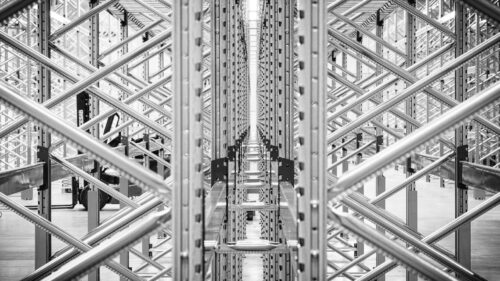
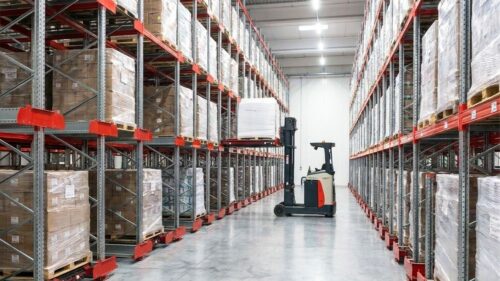
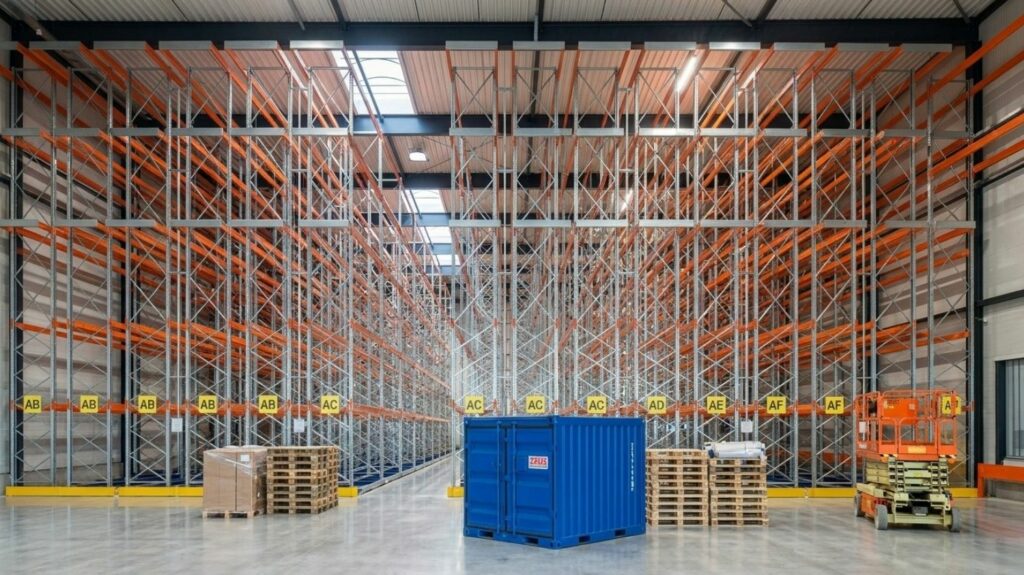
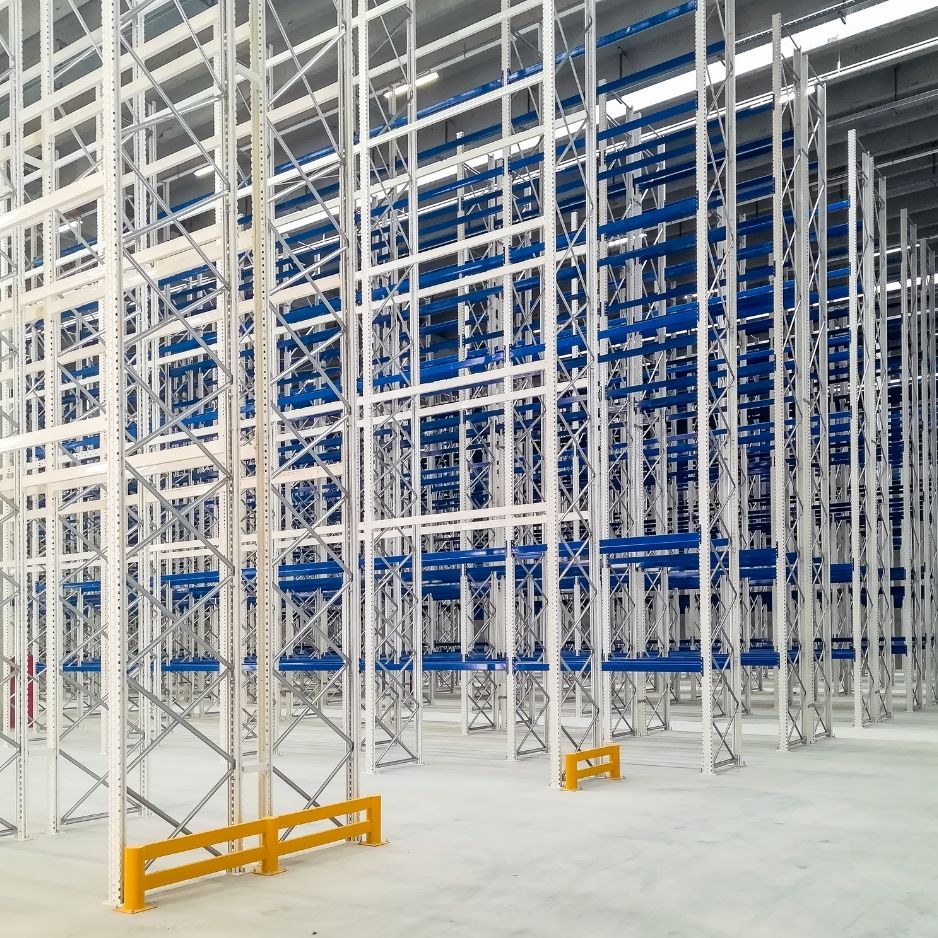
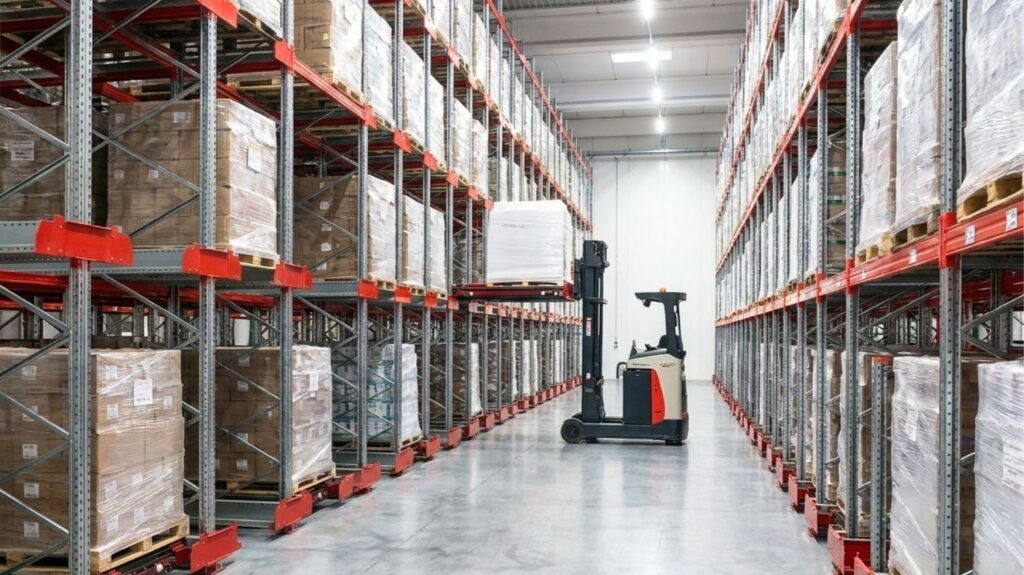
In drive-in racking, rows of racking are placed side by side with no aisles in between, forming deep lanes in which pallets rest on pairs of continuous rails fixed to the uprights. The forklift physically drives into the lane, advances to the first free position, sets the pallet down on the rails and reverses out along the same path.
The structure is reinforced but has no continuous load beams, and bracing is kept to a minimum to leave a clear path for the truck. Design refers to UNI 11575, while tolerances, use and maintenance fall under UNI EN 15620 and UNI EN 15635. Three operating characteristics follow:
These constraints are acceptable in a specific context: limited space, few SKUs, slow turnover. Where those conditions hold, we continue to recommend drive-in without hesitation — it is a solution we still install today — and in such cases the assessment can stop here.
In the installations we are asked to assess, however, those conditions have shifted — and rarely on just one front:
The first check we carry out, whether on an existing installation or a new project, is precisely this: counting how many of these fronts are already in play. When we find at least two at once, we put the second architecture on the table.
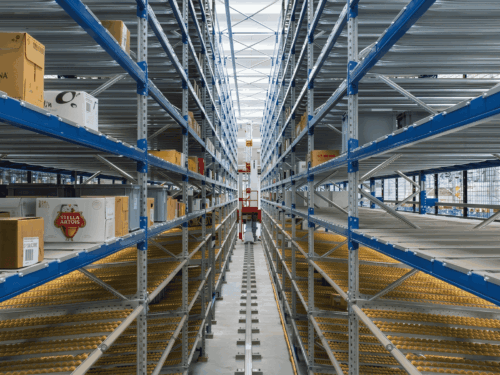
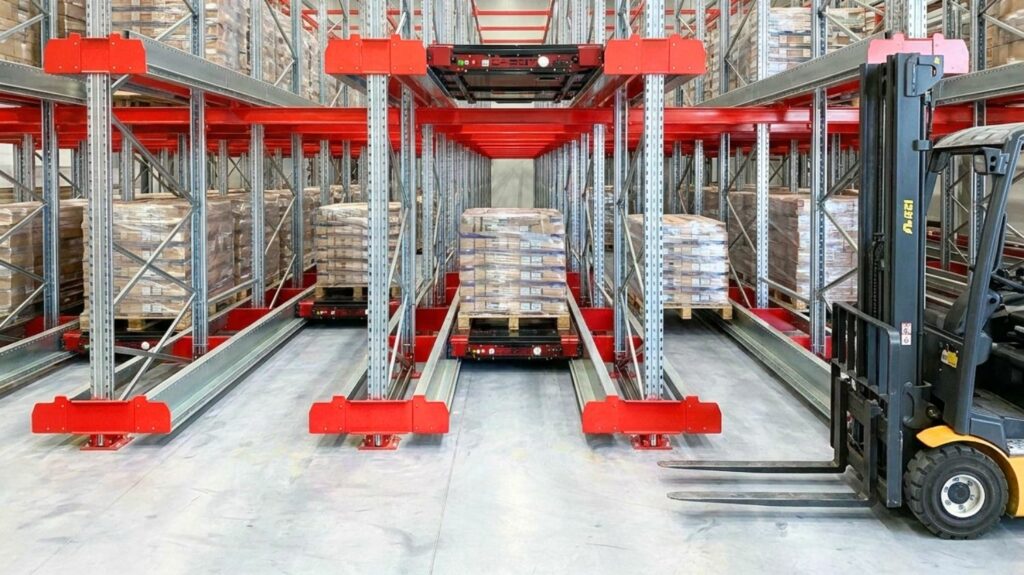
In satellite shuttle racking, the deep-lane structure stays, but what travels through it changes. The forklift stops at the lane entrance and never enters the racking: it places the pallet onto a shuttle — a low-profile motorised platform that runs on the same rails and lifts the load by a few centimetres — which then travels into the lane, positions the pallet and returns to the front on its own. The shuttle is battery-powered and radio-controlled; it is moved from lane to lane by the forklift itself, so a single satellite can serve many lanes.
Four direct consequences follow from this architecture:
On one point we want to be clear, because it is the one most often misunderstood: a satellite system is not an automated warehouse. It replaces neither the truck nor its operator, and it should not be compared with a stacker crane or a multi-level shuttle system. What it does is decouple the cycle, turning travel time into waiting time that can be filled with other work. The gain lies in equipment utilisation, not raw speed, and it should be measured as such: in truck-hours per pallet handled, not in seconds of travel.
With the two architectures clarified, the comparison comes down to three questions: how much of the volume can actually be filled, how well the structure holds up over time, and what can be done with the installation in the years that follow.
This is the parameter that most often overturns assessments made on paper. Our analysis of installations with equal nominal capacity puts the average steady-state utilisation of drive-in racking below 65%, and that of satellite shuttle racking above 80%. The gap is explained by reduced honeycombing (the formation of voids that cannot be reused in a deep-lane system) and by the ability to run FIFO flows, which frees up lanes without waiting for an SKU to run out.
Taken as orders of magnitude, these two figures change the way installed capacity should be read:
This is the methodological point that a comparison “at equal nominal capacity” tends to obscure: two installations with the same datasheet hold significantly different quantities of goods. Our advice to anyone weighing up two proposals is never to compare them on declared capacity, but to adjust that figure first for the utilisation expected on the real product mix — derived from order history, not from an industry average.
This comparison concerns parameters that no specification states and that only emerge once the installation is in operation, when the choice has already been made. Here, the difference between the two architectures lies entirely in how exposed the structure is to impacts from the truck.
Here we can draw on first-hand data. Through our Service Division we carry out more than 500 technical inspections a year and have classified over 250,000 anomalies. What we see is that damage is not randomly distributed: it concentrates on lower-level uprights, on rack ends, at aisle entrances and in the areas close to the loading bays — in other words, wherever handling density is highest. Drive-in racking, by its very design, brings that density inside the storage volume, in an environment with reduced visibility and tight tolerances, and does so on a structure that — with less bracing than pallet racking and no continuous beams — has smaller reserves of redundancy. There is also a figure we keep pointing out to the people we work with: around 60% of the anomalies we classify as red or amber are still present at the next inspection. In a structure with limited capacity to redistribute loads, that delay matters more than it would elsewhere.
Satellite shuttle racking does not eliminate maintenance: it introduces two items absent from drive-in, namely shuttle and battery maintenance and periodic software updates. These are, however, activities that can be planned, shifting the focus from reactive repair to scheduled maintenance — a difference that anyone running a warehouse on a continuous cycle will recognise immediately.
The advantages of satellite shuttle racking do not come from a single component but from the architectural choice described at the outset: separating the truck’s task from the shuttle’s. Every other benefit follows from that separation.
It follows that the criteria do not carry equal weight, and treating them as interchangeable items almost always leads to the wrong answer. The order of priority we follow in our analyses is:
Before this ranking can be applied, four figures are needed — and decision-makers rarely have them to hand:
Drive-in and satellite shuttle racking are not two generations of the same technology, but two different ways of dividing work between operator and machine within the same storage principle. The first places everything on the truck and the skill of the person driving it; the second hands handling in depth to a dedicated device and leaves the truck with the sole task of feeding the lane entrance. Today, the choice between them hinges on figures that most warehouses do not measure — and this is what interests us most: semi-automated systems, being instrumented, are beginning to generate the very data that has been missing until now. Once these figures are measured rather than estimated, the choice between manual and semi-automated compact storage will no longer be a matter of system-design preference, but a comparison of verifiable performance.
Describe your needs: our technical team will analyze the information to understand the operational context and provide you with feedback as quickly as possible.