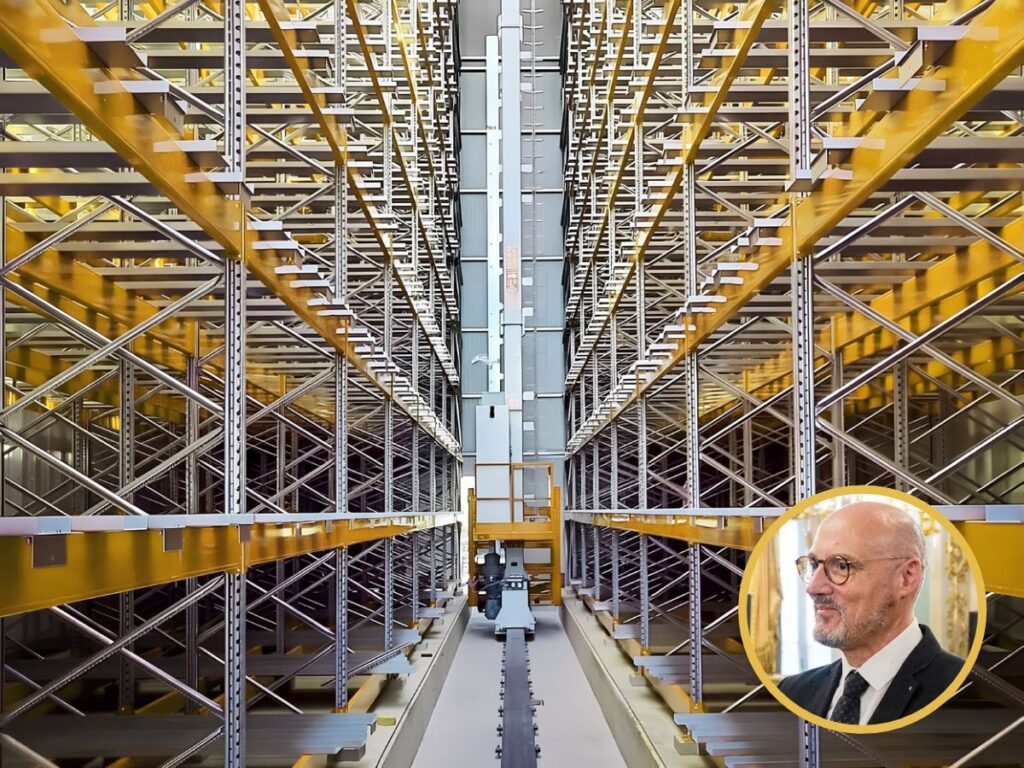




The growth of e-commerce, order fragmentation, smaller batch sizes and the need to respond ever more quickly are changing the role of the warehouse within organisations. In this context, automation is no longer just about machines and performance, but about the ability to integrate processes, data and people within a single operational system. Gianfranco Foglia is Technical and Sales Director at Logaut, a Modulblok Group company specialising in the development of technologies and systems for automated warehouse handling and storage.
In recent years, what has changed most in the way companies look at warehouse automation?
Above all, it’s the nature of the flows to be managed that has changed. Until a few years ago, the pallet was the main point of reference in terms of handling and volumes; today the market demands much more flexible systems, capable of managing fragmented flows, smaller orders and ever-greater levels of customisation. In many contexts, the conventional warehouse, designed to handle a few dozen movements an hour, is no longer enough to meet today’s needs. Companies are asking for solutions that are more versatile, faster and able to adapt to increasingly variable demands.
E-commerce is probably the clearest example of this transformation. Batch sizes have shrunk, shipments are far more fragmented and requests increasingly customised. Intralogistics therefore has to evolve to meet this new demand for speed, flexibility and responsiveness.
When a customer brings you into a project, is the problem to be solved only about the warehouse?
Less and less. Today the warehouse can’t be considered a stand-alone entity. To design an effective solution, you need to understand how goods are produced, how they arrive at the warehouse, how they’re handled and how they’re shipped to the end customer. That means analysing the company’s entire system: production, logistics, operational flows and distribution.
There was a time when the warehouse was seen mainly as a cost. Today it has become a productive component of the business, integrated with the processes that generate value. That’s why it has to be designed as an integral part of the organisation.
What are the main factors driving the evolution of automated systems today?
Speed and flexibility remain the key factors, but attention to energy efficiency is also growing rapidly. Technological development in the sector is strongly influenced by industrial component manufacturers, who are steering it towards increasingly energy-efficient systems. Today almost every installation incorporates some form of energy recovery and solutions designed to reduce consumption. A simple example is vertical movement: part of the energy used to lift a load can be recovered as it’s lowered, in much the same way as in hybrid vehicles. Energy isn’t yet the main selection criterion for customers, but it’s becoming increasingly relevant when it translates into lower operating costs and better use of available resources.
Italy’s Transizione 5.0 programme is also helping to raise this awareness, encouraging companies to assess installations not only in terms of productivity, but also of overall efficiency.
An automated system can also run around the clock and make better use of the available space. If I can store 10,000 pallets in a given area instead of the 5,000 possible with a conventional solution, I gain a significant benefit not only in terms of capacity, but also in the overall efficiency of the system.
As technological complexity increases, what role will people continue to play?
A central one. Automation mainly eliminates the most repetitive and manual tasks, but it increases the demand for specialist skills. It’s something we’ve seen many times throughout history, from the Industrial Revolution to the arrival of computers: each time, people thought certain professions would disappear, when in fact they were transformed.
The same is happening in automated warehouses. Behind every system, you need people who can manage complex processes, interpret data and handle the interaction between humans and machines. We’re not seeing the human role shrink, but evolve. The skills required are changing, but people remain essential to ensuring reliability and operational continuity.
Is the education system able to provide these skills, or does training remain largely the responsibility of companies?
Training is still largely the responsibility of businesses. Today the hardest skills to find are in automation, PLC programming and the interconnection between software and physical systems. Mechanical expertise is still important, but it’s the digital side that requires the greatest investment.
In my view, the technical standard in Italy remains high. The real difficulty is finding people willing to pursue careers that demand constant upskilling, fieldwork and a high degree of specialisation. Commissioning an automated system requires well-trained technicians who can tackle complex problems on site, at the customer’s premises. And above all, it requires ongoing training. In this sector, what’s current today could be outdated within a few months. That’s why training can’t be seen as an occasional activity, but as a permanent process.
Artificial intelligence, without a doubt. It’s already being used in software development and to manage repetitive tasks. We’re not talking so much about machine language as about generating code, operating sequences and standardised procedures. You feed data into the system and the AI independently develops part of the program code required, which is then checked and validated by technicians.
The most interesting prospects, however, lie in analysing logistics flows, handling operations and operational performance. Increasingly advanced systems will be able to process large amounts of information and support decision-making at a speed that conventional tools would struggle to match.
Even so, I believe the creative component will remain central. AI can speed up many activities and support design, but innovation still comes from experience, from the ability to interpret problems and from people’s intuition.
Automation is often thought of as a succession of technologies, each replacing the one before. In reality, industrial evolution follows a different logic. The most significant innovations almost always come from improving existing solutions and reinterpreting established principles.
Automation is a continuous process of evolution. Materials change, electronic components change, control systems change, but the fundamental principles are constantly updated and adapted to new needs. If we look at how markets have evolved, from e-commerce to the growing fragmentation of orders, we can see how many technologies have been rethought to respond to contexts completely different from those they were originally conceived for.
That’s why I see artificial intelligence as an accelerator of skills, not a substitute for them. Like every innovation that came before it, it’s a new step along a path of continuous evolution.
I don’t think so. Not in the short term, at least. AI is a very effective, practical tool for analysing and processing data, automating repetitive tasks and supporting decision-making. But it still works mainly on existing information and models.
“The most significant innovations almost always come from improving existing solutions and reinterpreting established principles”
Describe your needs: our technical team will analyze the information to understand the operational context and provide you with feedback as quickly as possible.