
Ever-larger catalogues, smaller and more frequent orders, tighter delivery windows: in many distribution centres, the growth in SKUs has shifted the bottleneck from storage to picking.
When the unit to be handled is no longer the full pallet but the individual carton, every order line translates into travel, searching and potential errors. A miniload system for picking addresses this problem: it automates the storage and replenishment of boxes and crates and brings the goods to the operator, rather than the other way round. This article sets out its principles and applications, examines a multi-depth handling technology and looks at it in operation at a beverage logistics hub.
In conventional carton picking, the operator goes to the goods: walking the aisles, finding the location, picking and moving on. Part of the time spent on each order line is therefore taken up by travel and searching, and every search is an opportunity for error.
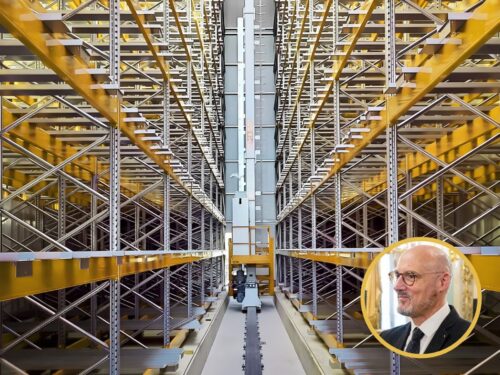
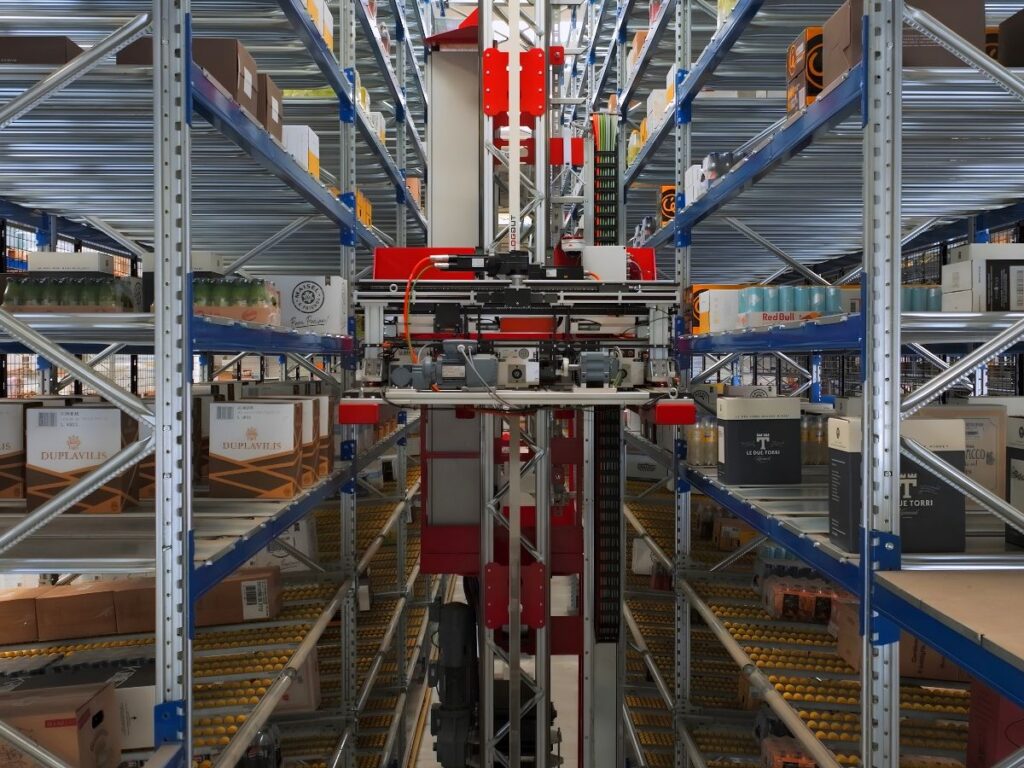
A miniload system reverses this relationship. With the goods-to-person approach, the carton comes to the operator, and manual handling is reduced (automated miniload warehouse).
A miniload system supports picking in two ways:
The system can be integrated with manual, semi-automated or automated picking.
The deciding factor is not storage capacity but the picking profile. A miniload system for picking is justified where there are:
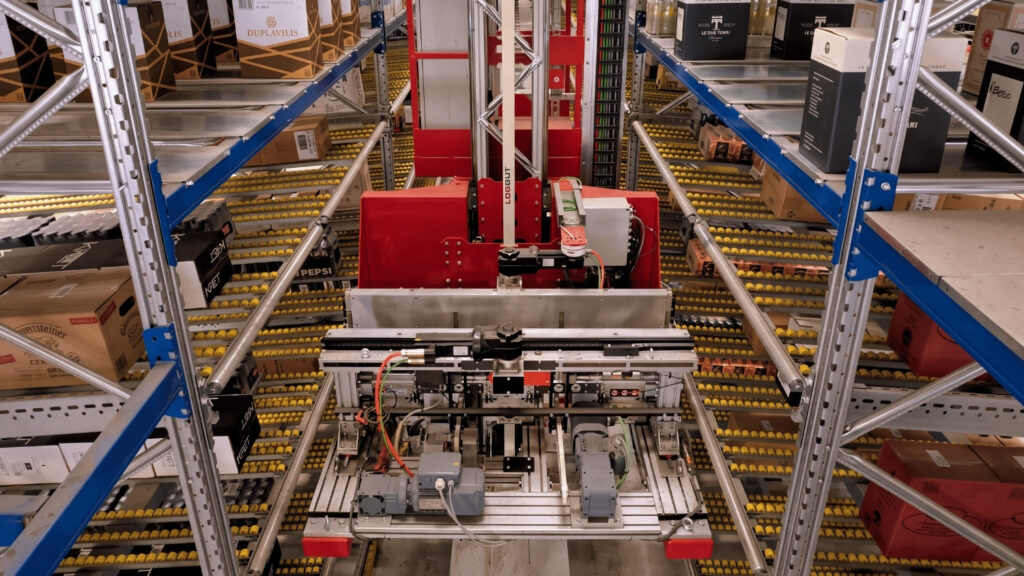
The Arachne miniload is developed by Logaut, the Modulblok Group company dedicated to automation. It is a stacker crane designed to optimise space and the handling of crates and boxes, with telescopic forks that can handle up to four boxes at once.
The machine moves along three axes, X, Y and Z. Its main components are:
Telescopic forks are extendable arms that enter the rack bay from the side: they deposit or retrieve the load unit while the machine remains in the aisle. The finger-type system is the means by which the forks hold the box as it is extracted.
Multi-depth handling makes it possible to move several boxes in a single mission. In picking, this means replenishing a station with several cartons on each trip, rather than repeating the cycle for each one.
The technology offers three configurations. As the number of boxes per mission increases, the permitted weight of each box decreases:
The choice depends on the carton profile. Light, uniform products make the most of quadruple-deep handling; heavier cartons require double-deep.
Speed and acceleration. Maximum speed is 3 m/s both unladen and laden, with acceleration of 0.5 to 1 m/s².
Accuracy. Positioning is by laser and barcode, with an accuracy of ±10 mm. In box picking, accuracy determines the alignment between the forks, the location and the destination station, especially when several cartons are deposited in sequence.
Height and temperature. Maximum height is 12 m. The operating temperature range is +5 to +45 °C, so the machine operates outside cold rooms kept below +5 °C.
| Parameter | Value |
|---|---|
| Axes of movement | X, Y, Z |
| Gripping system | Telescopic forks with finger-type gripping |
| Positioning | Laser and barcode |
| Positioning accuracy | ±10 mm |
| Maximum speed (unladen and laden) | 3 m/s |
| Acceleration | 0.5–1 m/s² |
| Maximum height | 12 m |
| Maximum length (Y) | 4 m |
| Maximum width (Z) | Varies with the number of depths |
| Operating temperature | +5 / +45 °C |
| Maximum payload | Up to 120 kg (triple-deep) |
| Double-deep | 2 boxes × 50 kg = 100 kg; dimensions A and B max 600 mm |
| Triple-deep | 3 boxes × 40 kg = 120 kg; dimensions A and B max 600 mm |
| Quadruple-deep | 4 boxes × 25 kg = 100 kg; dimension A max 400 mm, dimension B max 600 mm |
Eurobevande operates in beverage distribution with a multi-temperature logistics hub of more than 20,000 m², constrained by a clear height of 6,700 mm (Modulblok, Eurobevande case study). The facility also includes two Traslo Raider systems, AGVs, vertical lift modules and cold rooms; this analysis focuses on the miniload.
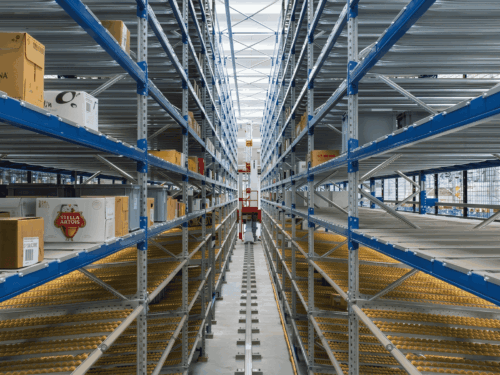
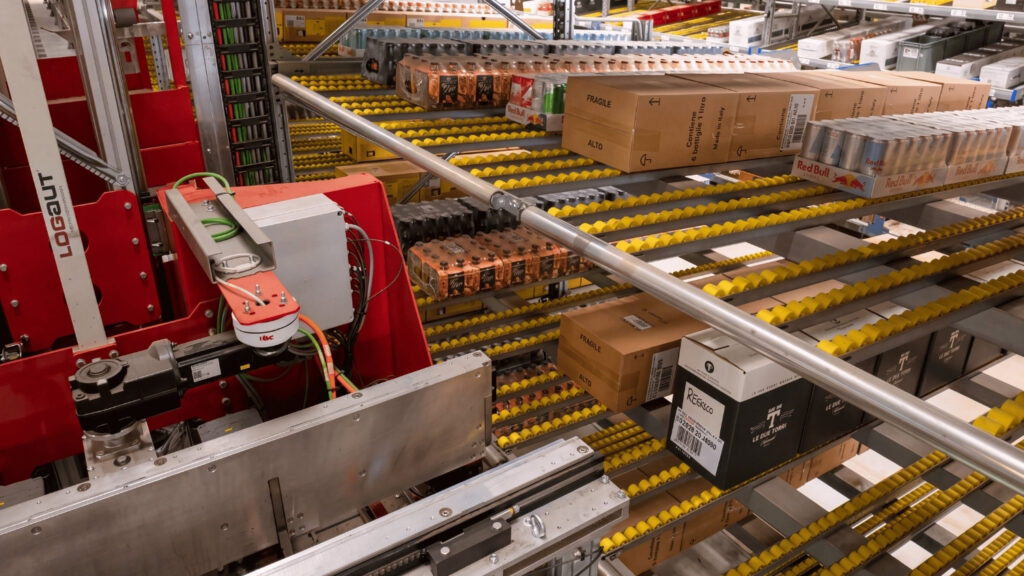
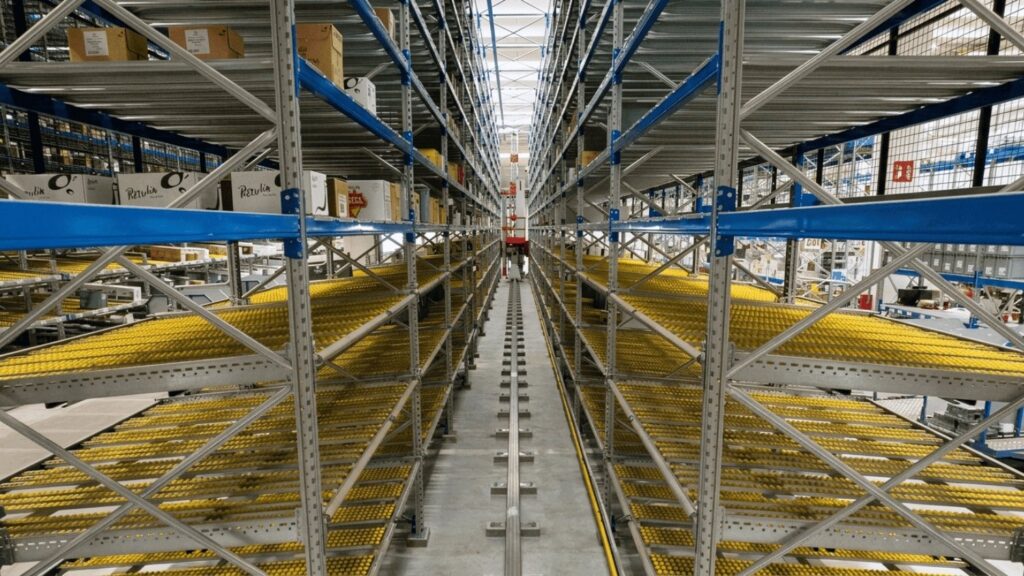
Picking remains manual. Operators ride tugger trains and, with the same vehicle, serve several types of station. These include carton flow lanes: inclined roller lanes in which cartons move by gravity from the loading side to the picking side.
In this setup, the miniload does not bring the carton to the operator at a dedicated bay: it replenishes the lanes from which the operator picks, separating automated replenishment from picking.
The miniload has a capacity of 12,000 cartons and feeds the carton flow lanes using Arachne.
Handling can be of two types:
Carton flow lanes can be assigned in two ways:
SKUs are allocated according to three criteria:
A supervisory WMS coordinates missions and routes across the entire logistics hub. There are two benefits for picking:
A miniload system for picking is not just a more compact automated warehouse: it is a way of reorganising the relationship between stock, replenishment and picking. The Eurobevande case shows that it can work alongside manual picking, feeding gravity lanes with multiple or singulated handling and allocating SKUs according to explicit rules.
The configuration, from the number of depths to lane assignment, depends on the carton and order profile. Actual throughput should be verified on cycle time, not peak speed. The starting point remains an analysis of handling data. To assess it with a technical team, you can request a consultation on miniload warehouses.
What is a miniload system?
A miniload is an automated warehouse for light, standardised load units such as crates, containers, totes and cartons. Dedicated stacker cranes travel along the aisles of multi-level racking and bring the units to conveyors and workstations, following the goods-to-person approach, under the control of WMS/WCS software.
When is a miniload system worthwhile for picking?
It is worthwhile when there are many SKUs, picking is the core of the process and load units are light, standardised and fast-moving. It is also suited to operations that require accuracy, traceability and operational continuity, such as e-commerce, spare parts, pharmaceuticals or production line feeding.
What is the difference between multiple and singulated handling?
With multiple handling, the miniload deposits several cartons into a lane in a single mission, an approach suited to replenishing a fixed pick location. With singulated handling, it moves the single carton required by the order, which is useful when the lane collects cartons already grouped by customer.
What are multi-depth telescopic forks?
They are extendable arms that enter the rack bay and handle several boxes in the same mission. On Logaut’s Arachne miniload, configurations range from double-deep, with two boxes of up to 50 kg each, to quadruple-deep, with four boxes of up to 25 kg each.
Describe your needs: our technical team will analyze the information to understand the operational context and provide you with feedback as quickly as possible.