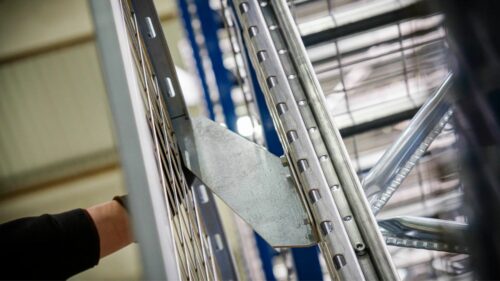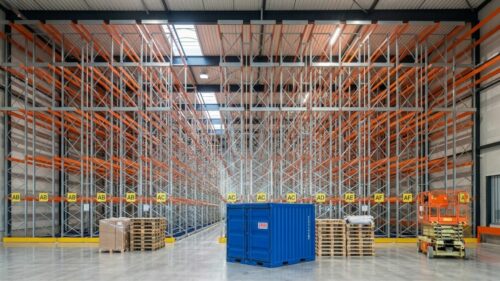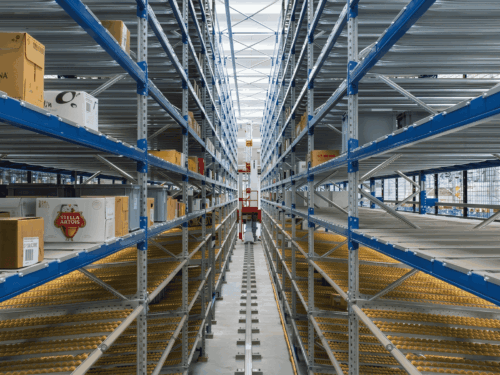





A tight manoeuvre, a fork brushing against an upright, a mark on the metal. These are everyday occurrences in any warehouse, but each one may conceal a loss of load capacity that is invisible to the naked eye. Here is how the standards teach us to recognise damage, classify it and, above all, reduce it.
It happens in every warehouse: a truck touches an upright and leaves a mark. It doesn’t look like much. Yet the tests referred to in UNI EN 15635 show that moderate damage to an upright can reduce its load capacity by 30–40%.
There is an even more telling figure: almost all damage is caused by the equipment operating between the racks. Not by exceptional events, but by day-to-day operations.
Under Italian law (D.Lgs. 81/2008), racking is work equipment, just like a forklift truck or a machine. It must therefore be kept safe throughout its life, not just on the day it is commissioned. And there is a precise method for doing so: recognise the damage, measure it, classify it, act on it.
Damage management does not rely on a single reference, but on a set of complementary standards. The cornerstone is UNI EN 15635, which governs the application and maintenance of storage equipment; the others address the technical aspects it leaves open.
| Reference | Its role in damage management |
|---|---|
| UNI EN 15635:2009 | Management procedure, appointment of the PRSES, inspection system, damage classification |
| UNI 11731:2018 | Assessment criteria for uprights, bracing, beams and anchors; requirements for reinstatement |
| UNI EN 15620:2021 | Tolerances, permissible deformations and reference clearances |
| UNI 11636:2023 | Documentary, structural, assembly and in-use validation throughout the service life |
| CSLLPP Guidelines 2023 | Checks on existing racking and assessment of seismic vulnerability |
Technical standards are voluntary, but Italian Legislative Decree 81/2008 provides the framework for the entire system. Applying them is the most robust way to demonstrate that you have acted in line with the state of the art.
UNI EN 15635 (clauses 9.5.2–9.5.4) classifies all damage into three levels, following a traffic-light logic. The criterion is not what the damage looks like, but by how much the measured deformation exceeds the permitted limit.
Green: monitor. The deformation limits are not exceeded. No reduction in load capacity or repair is required: the component is recorded and re-examined at the next inspection.
Amber: action as soon as possible. The limits are exceeded by a factor of less than two. The standard already requires the component to be replaced, and the affected positions must not be reloaded. If the damage has not been remedied within four weeks, the standard recommends reclassifying it as red.
Red: immediate action. The limits are exceeded by a factor of two or more. The area must be unloaded immediately and made inaccessible until it has been repaired, following a documented isolation procedure.
A common misconception concerns the amber level, which is often read as “minor damage”. It isn’t: it calls for replacement, with a precise deadline beyond which the risk becomes unacceptable.
Classification presupposes a role that the standard makes mandatory: the PRSES, Person Responsible for Storage Equipment Safety. This person is formally appointed by management, with responsibility for keeping the storage system safe, and must have appropriate training, authority and decision-making autonomy.
The PRSES should not be confused with the RSPP, the head of the prevention and protection service required under Italian law. The RSPP has an overall view of company safety; the PRSES deals exclusively with storage equipment. The role can be filled by an employee or by an external party, including the racking supplier, provided they meet the requirements of a competent person. According to a 2026 study by INAIL, Italy’s national institute for insurance against accidents at work, which reflects the authors’ own views, at least one PRSES is needed per site and per shift.
Their typical mandate includes three powers: reporting non-conformities to the employer, stopping the use of the racking in the event of serious and imminent risk, and requesting maintenance or technical inspections. They must be able to put safety before any other duty, even when their decisions affect operations.
The PRSES is the linchpin of a three-level inspection system (clause 9.4):
Everything feeds into the racking inspection log, the documentation to be presented to the enforcement authorities, to which external reports must always be attached.
Classification always starts with a measurement. The method is described in clause 9.5.1 of UNI EN 15635 and involves three steps:
The measured value is compared with these limits:
| Member and direction of deformation | Limit over 1 m |
|---|---|
| Upright, in the direction of the beams | 5 mm |
| Upright, in the plane of the frame | 3 mm |
| Bracing, in both planes | 10 mm |
An example illustrates the criterion. An upright is deformed by 7 mm in the direction of the beams. The limit is 5 mm, so it is exceeded 1.4 times: the damage is amber. From 10 mm upwards, the limit is exceeded twice over: the damage is red.
The standard adds three rules:
Then there is the verticality of the racking, known as out-of-plumb. It is expressed as a fraction of the upright height H. For racking in service, the 2023 CSLLPP Guidelines, issued by Italy’s Higher Council of Public Works, set the limit at H/200: on a 10 m upright, that is 5 cm. For loaded beams, the maximum deflection is L/200.
After installation and after every reinstatement, stricter limits apply, set out in UNI EN 15620:
| Condition | Maximum out-of-plumb |
|---|---|
| Wide and narrow aisles | H/350 |
| Very narrow aisles | H/500 |
| Racking served by stacker cranes | H/1000 |
Limits of just a few millimetres may seem excessive. The informative Annex D of UNI EN 15635 shows otherwise, with an example based on the rated load.
The design resistance equals the load multiplied by 1.4 (the safety factor on loads) and by 1.0 (the factor on the material). Damage that removes 40% of capacity brings the ratio between resistance and load down to 1.40 × 0.6 = 0.84. Below 1, there is a risk of collapse.
Real-world reserves, such as steel 15% stronger than the minimum and an actual load at 80% of the rated value, bring the ratio back up to 1.21. These margins, however, are neither guaranteed nor verifiable during an inspection. The compression tests cited by the standard confirm losses of 30–40% even with moderate damage, and current knowledge does not make it possible to predict precisely the effect of any specific damage.
Research by TNO Bouw (the Netherlands) and Lund University (Sweden) has confirmed this approach. Clause 9.3 adds an operational warning: collapse may not be immediate and can occur over a period of hours or days.
UNI 11731:2018 supplements UNI EN 15635 with component-specific classification criteria, including where measuring with a straight edge is not enough. Since quantifying residual load-bearing capacity is very difficult, the standard takes a precautionary approach: when in doubt, the higher severity level is assigned.
| Component | Red damage · immediate action | Amber damage · scheduled action |
|---|---|---|
| Upright | Obvious change in shape, visible without measurement; localised tears in the section | Twisting of the profile with no obvious signs of impact, attributable to rotation of the base plate: this must be corrected by adjusting the fixings; if this does not resolve it, the damage is red |
| Beam | Connector hooks broken, deformed or ineffective; dents over 5 mm on one face of the profile; splaying of the overlapping edges in double-C sections extending to the adjacent sides; broken, damaged or corroded stitch welds | Lifting of the top fold not extending to the adjacent side; bulging of the side face of less than 5 mm |
The standard also introduces a key principle: the level of damage and the level of risk may not coincide. Classification is an objective reference, whereas risk assessment is the responsibility of a competent person, based on how heavily the component is stressed.
The same deformation on an upright at the first level, the most heavily stressed, is more critical than in a lightly loaded area. Before the racking is returned to service, an expert must therefore assess the cause of the deformation and establish the conditions for safe use.
Before planning any work, UNI 11731 requires the damage to be traced back to its cause. If an upright has been deformed by a forklift impact, replacement may be enough. If the deformation results from overloading or from use other than that for which the racking was designed, replacing the component does not solve anything: the problem lies further upstream.
The correct process links UNI EN 15635, UNI 11731 and UNI 11636 in six stages:
The recommended action is replacement with an identical component, which restores performance to the levels declared by the manufacturer without the need for recalculation. If the replacement component is of a different type, UNI 11636 also requires structural validation, as performance may not be equivalent.
Repair, on the other hand, is not recommended. Clause 9.7.1 of UNI EN 15635 rules it out unless approved by the supplier, given the difficulty of carrying out effective quality checks on cold-formed profiles. UNI 11731 only allows it on the basis of a written procedure from the structural designer, with documented approval.
The European Racking Federation has issued a dedicated technical bulletin on straightening uprights: there is no validated scheme for certifying that structural behaviour has been restored. Two firm constraints also remain: a frame component with residual deformations classified as amber or red is never repaired, and local reinforcements are only permitted if designed and verified by a qualified engineer.
All work must be carried out by specialist operators, with the relevant section of racking unloaded. On completion, plumb is checked in accordance with UNI EN 15620: the final safety level must not be lower than that of the undamaged structure.
Impact damage follows recurring patterns: it is concentrated on a few components, at specific heights and in specific warehouse areas. This is documented by the historical data of the Modulblok Service department: more than 4,000 inspections across over 600 sites, with more than 250,000 anomalies coded by component, severity, position, racking type and warehouse area.
Beams and uprights are the most affected components. Together they account for around half of all red anomalies (25.9% beams, 25.1% uprights) and appear in 51% and 47% respectively of sites with serious anomalies.
The critical zone is the first three levels. Around 80% of red anomalies on beams are concentrated here, with the first level alone accounting for 37%. This distribution reflects how forklift trucks operate, working mainly at the lower levels.
The risk profile varies by area. Drive-in racking and cold stores have the highest shares of red anomalies, at 22% and 21% respectively. Pallet racking areas have the largest volume of anomalies, but a lower relative severity, at around 12%.
The critical point is closing out anomalies. Only 40% of red and amber anomalies have been resolved by the following visit. The inspection flags them, but action does not follow: most companies do not have an organised maintenance programme.
Continuity produces measurable results. At sites that inspect regularly and act on anomalies, the Warehouse Score Index, a composite index from 0 to 100 currently being developed by Modulblok, rises from 76.2 at the first visit to 85.6 at the sixth (+9.4 points). At sites that do not act, damage does not stabilise: it accumulates.
The data point to the operational levers for reducing impact damage:
Racking damage is prevented through knowledge of the standards and day-to-day operational control. It is managed through clear processes: measurement, classification, risk assessment and action in line with the standards. It is reduced over time only through structured monitoring and targeted corrective action.
A safe warehouse is not a warehouse free of damage. It is a warehouse where all damage is detected in time, dealt with methodically and closed out with full documentation.
Describe your needs: our technical team will analyze the information to understand the operational context and provide you with feedback as quickly as possible.