Research and development
Academic Research & Development

Collaboration with the academic world is one of the pillars of our innovation strategy.
In partnership with the University of Udine, Politecnico di Milano, the Universities of Pavia and Trento, and Griffith University in Brisbane (Australia), we conduct laboratory testing, structural trials, and material analyses to validate the mechanical performance of our storage systems in line with the highest European safety standards.
The mechanical characteristics of system profiles and joints—critical knowledge for proper structural design—are determined through certified experimental tests carried out by specialized university laboratories, in compliance with the protocols defined by the relevant European standards (EN 15512).
Key types of experimental testing include:
- Stub column tests
- Compression tests on uprights
- Bending resistance tests on beam–upright joints
- Initial slip tests on beam–upright joints
- Shear tests on beam–upright joints and anti-disengagement devices
- Floor anchorage tests
- Shear stiffness tests on frame bracing
- Bending resistance tests on upright cross-sections
Alongside applied research, we support educational projects with interns and master’s degree candidates, contributing to the development of new engineering expertise. Thesis and internship activities address advanced topics such as:
- Application of nonlinear numerical methods and simplified approaches for predicting the mechanical behaviour of joints
- Fatigue analysis of rails in automated warehouses
- Evaluation of effective buckling length in frames with semi-rigid joints
- Nonlinear static and dynamic analysis of unbraced racking systems
- Studies on isolation systems for steel storage structures
- Analysis of non-uniform torsion and instability in thin-walled built-up profiles
Through these collaborations, we bring together scientific research and industrial engineering, turning academic experimentation into concrete solutions that enhance the safety, reliability, and technological evolution of the warehouses of the future.

European Projects and Innovation Programmes
Participation in European research projects enables Modulblok to make a concrete contribution to the advancement of technical standards and structural safety criteria in the industrial racking sector.
Within this framework, the company has taken part in high-level projects such as STEELWAR and SEISRACK2, promoted under European programmes dedicated to research on thin-walled steel systems, deformable structures and seismic performance of rack-supported warehouses.
Steelwar – Advanced structural solution for automated STEELrack supported WARehouses
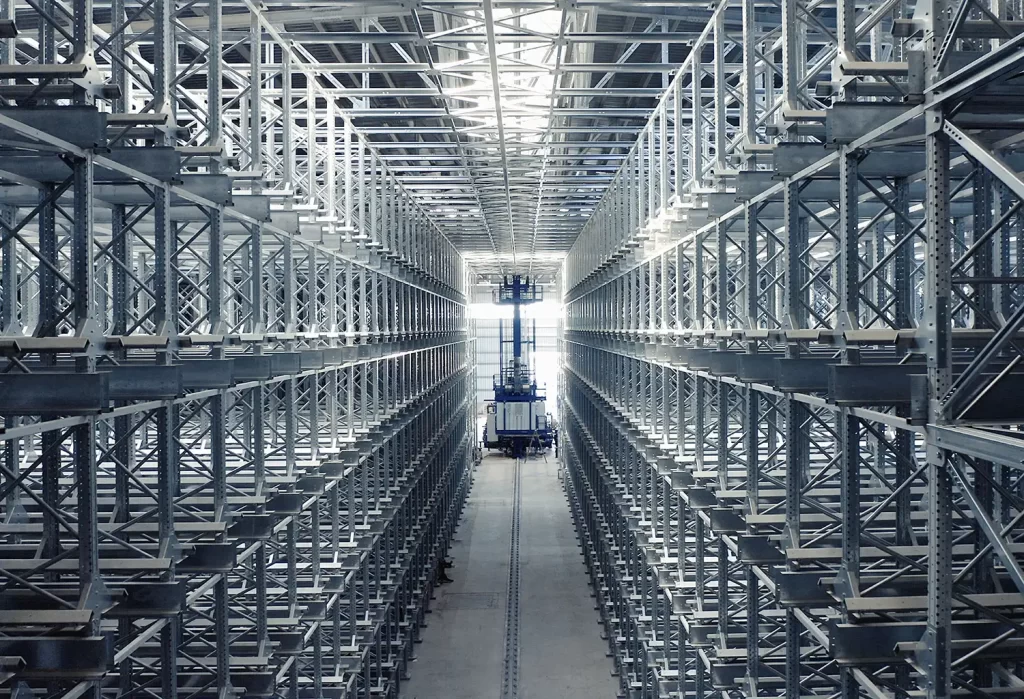
Modulblok played an active role in the STEELWAR project, whose objective was to develop new design approaches specific to rack-supported warehouses (ARSWs) under both seismic and non-seismic conditions, addressing the absence of dedicated design codes.
The research analysed the full lifecycle of these structures—from erection to full operational service—developing advanced safety criteria and an innovative dissipative seismic design model.
The project also investigated in depth:
- functional configurations of rack-supported warehouses,
- critical phases during construction,
- wind actions on bare or partially clad structures,
- real logistical loading scenarios and their structural impact.
The work defined characteristic load conditions, combination factors, 3D and simplified modelling criteria, as well as new seismic parameters (q-factor and overstrength coefficients).
The final outcome is a set of innovative guidelines for designing safer, higher-performance rack-supported warehouses aligned with the needs of modern logistics.
Seisrack2 – Seismic Behaviour of Steel Storage Racking Systems
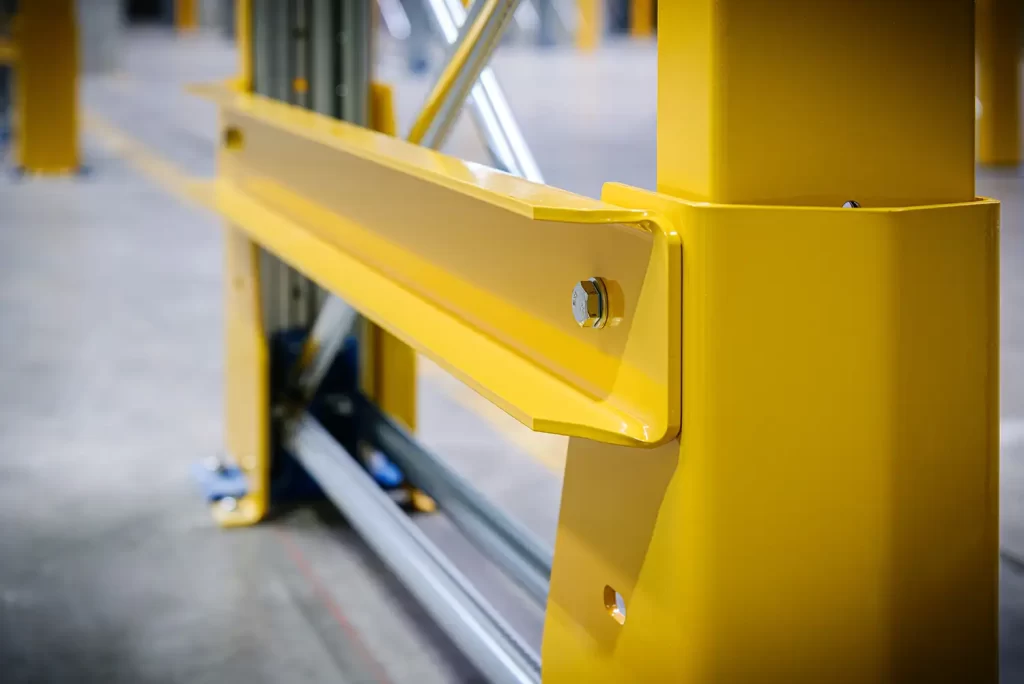
This project explored the seismic response of industrial racking systems through nonlinear dynamic analyses and full-scale shake-table testing.
Its aim was to develop reliable predictive models for the cyclic and dissipative behaviour of racking structures, assessing:
- the interaction between the structural frame and unit loads,
- damage propagation in joints and beams,
- performance-based verification criteria for seismic-zone design (ref. EN 16681).
Thanks to these initiatives, Modulblok has been able to integrate advanced calculation methodologies and innovative testing protocols into its industrial practice, strengthening its position as a reference technical partner in the European landscape of structural engineering applied to logistics.
These experiences now form the foundation of our approach to safe and sustainable warehouse design, fully aligned with the most updated European standards